
CONTINUITY + VERIFY · BUSINESS INTERNET CONTINUITY IN GHANA
Built for continuity.
Backed by evidence.
Two independent internet connections — your current provider can be one of them — and a router that moves you between them by itself.
GHS 500, fully credited against your first invoice if you proceed.
Subsea Cable Provider international outage, 31 Aug – 5 Sep 2026
66 min
A fibre cut happens somewhere in Ghana roughly every 66 minutes — more than 8,000 every year. Most businesses only find out when the card machine stops.
Source: Ghana Chamber of Telecommunications CEO, May 2026. Industry-wide figure — not a Teledata statistic.
WHAT YOU GET
Four things your internet has never given you
Continuity + Verify is a managed service: two independent connections, one router that switches between them, and a record of what happened.
Availability
When your primary internet fails, or is up but losing packets or running badly slow, C+V moves you onto your backup connection, and moves you back automatically once the primary has been stable for several minutes.
Quality
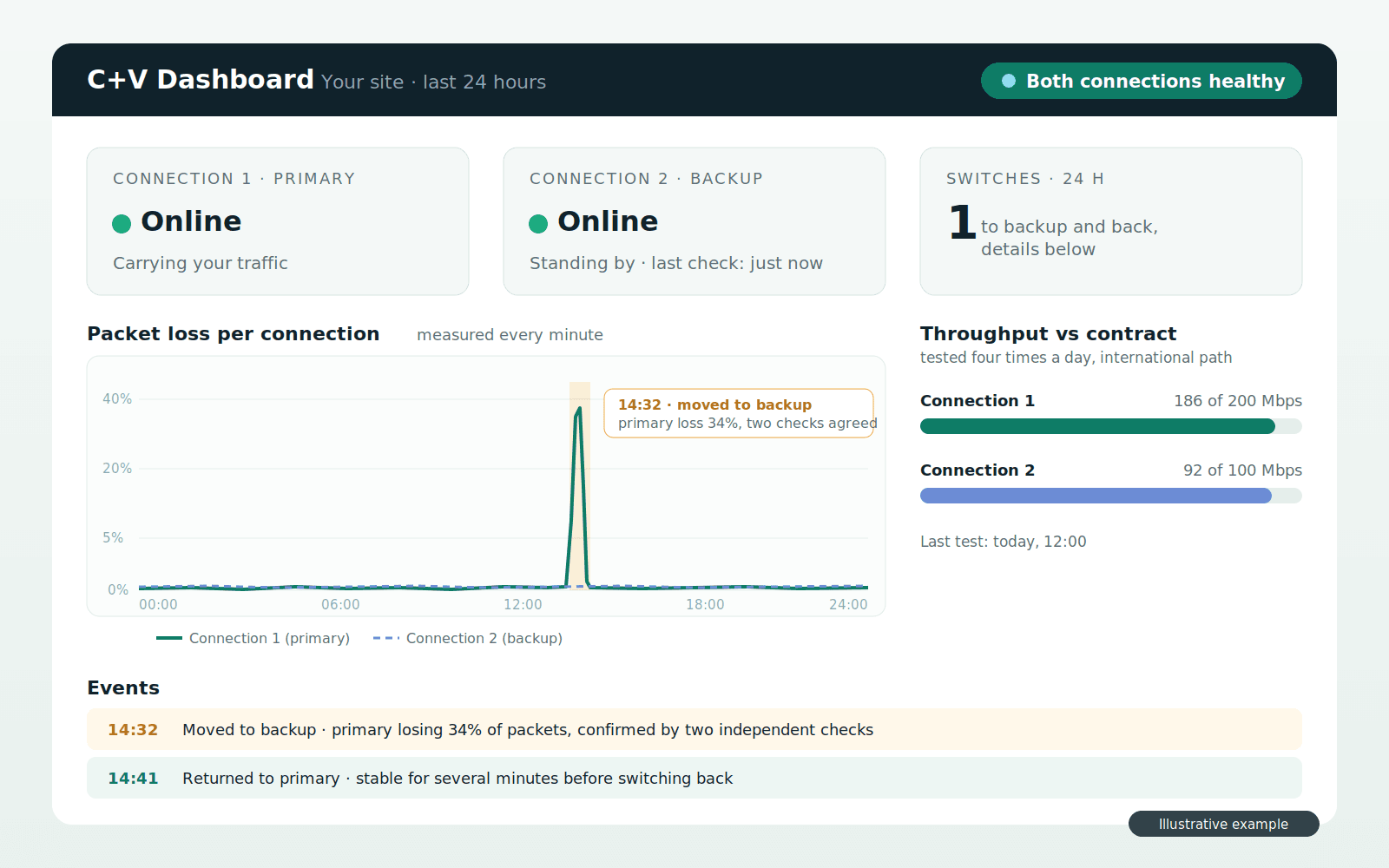
A connection that is up but losing packets or running badly slow is treated as failed. At sites with the on-site monitoring node, each connection's packet loss and route to a Teledata-owned server abroad are checked every minute.
Capacity
At sites with the on-site monitoring node, the throughput each connection delivers is measured against its contracted speed four times a day, against a Teledata-owned server in London, so it reflects the international path your traffic actually takes.
Visibility
Every C+V installation includes your own dashboard: the state of both your connections, every switch, and the measurements behind it. At sites with the on-site monitoring node, it also shows the throughput each connection delivers against its contracted speed, and its packet loss. Every switch, and every failure of your backup, is also reported to Teledata's operations centre within seconds.
Three steps to a setup you can trust
Step 1
Continuity Check
An engineer audits your site: your providers, the physical paths they take, your critical applications, your risk. You get a written report and a recommended design — whether or not you proceed.
Step 2
Your design
We pair your primary with a backup from a different provider or technology, such as fibre from another provider (MTN, Telecel or Comsys) or Starlink. Teledata reviews every pairing before quoting, and every installation is proven with a live failover test before service starts. You own the hardware; we manage it.
Step 3
Managed and measured
Monitoring and failover run automatically 24/7, with human follow-up in the service window. Every switch is reported to Teledata with the measurements that caused it.
START HERE
The Continuity Check
- Site audit and a review of your pairing, at the last mile and internationally
- Review of your critical applications (calls, payments, cloud)
- Written report with a recommended design
- Yours to keep — even if you don’t proceed
GHS 500 one-time
Fully credited against your first invoice if you proceed within 90 days — free if you go ahead.
Book my CheckBook your Continuity Check
Two minutes. A Teledata engineer follows up the same working day.
During the Subsea Cable Provider international outage of 31 August – 5 September 2026, a C+V customer's primary connection failed eleven times and C+V switched correctly every time.
In a live test witnessed by the customer's IT team, a C+V site lost its fibre and was on its backup in under a minute, ran all services, and returned to fibre automatically.
What to expect, stated plainly
- On every switch, in both directions, calls in progress drop and connections restart; cloud applications may ask you to log in again.
- A switch typically takes about a minute. The return to your primary is deliberate, after several minutes of proven stability; a primary that keeps failing is held on the backup until a Teledata engineer confirms it.
- On a Starlink or MTN Fibre Broadband backup, nothing inbound reaches your site until the primary returns.
- The backup runs at the backup provider's speed, not your primary's.
- Your two connections must be independent at the last mile and internationally. Teledata reviews the pairing before quoting; a shared international route is not protected against.
- At sites with the monitoring node, the throughput test fills each connection for 20 seconds, four times a day.
- Monitoring and failover are automated 24/7; human follow-up happens Mon–Fri 08:00–17:00, Sat 09:00–13:00.
- Your backup service must be kept paid and current. Who renews it is written into your contract.
- While your primary is down, our central monitoring can't see your site; the on-site node keeps the record.
- How long an alert lasts is not how long you were affected; any outage time we report comes from the measurements.
- C+V is built not to switch on a single faulty measurement, but it cannot promise never to switch unnecessarily.
STRAIGHT ANSWERS
Questions businesses actually ask
Will my calls drop when the connection switches?
Yes. When it switches, typically within about a minute, calls in progress drop and connections restart, in both directions.
Do I have to change my internet provider?
No. Your current provider can be one of your two connections. C+V is proven today with a Teledata primary; other pairings are assessed in the Continuity Check and proven with a live failover test at installation.
What happens if both connections fail?
You're offline until one recovers; nobody can honestly promise otherwise. Teledata reviews your pairing so the two connections don't share a path we can see, because two "different" providers can share the same trench.
Is support really 24/7?
Monitoring and failover are fully automated, 24/7. Human follow-up runs Mon–Fri 08:00–17:00 and Sat 09:00–13:00, with extended cover available as a bespoke arrangement.
Is my backup always ready?
No one can honestly promise that. C+V reports every failure of your backup to Teledata within seconds; the backup service itself must be kept paid and current.
Can Teledata see my business data?
No. The monitoring measures your connections — latency, loss, throughput — not the content of your traffic. We see how your internet performs, not what you do on it.